
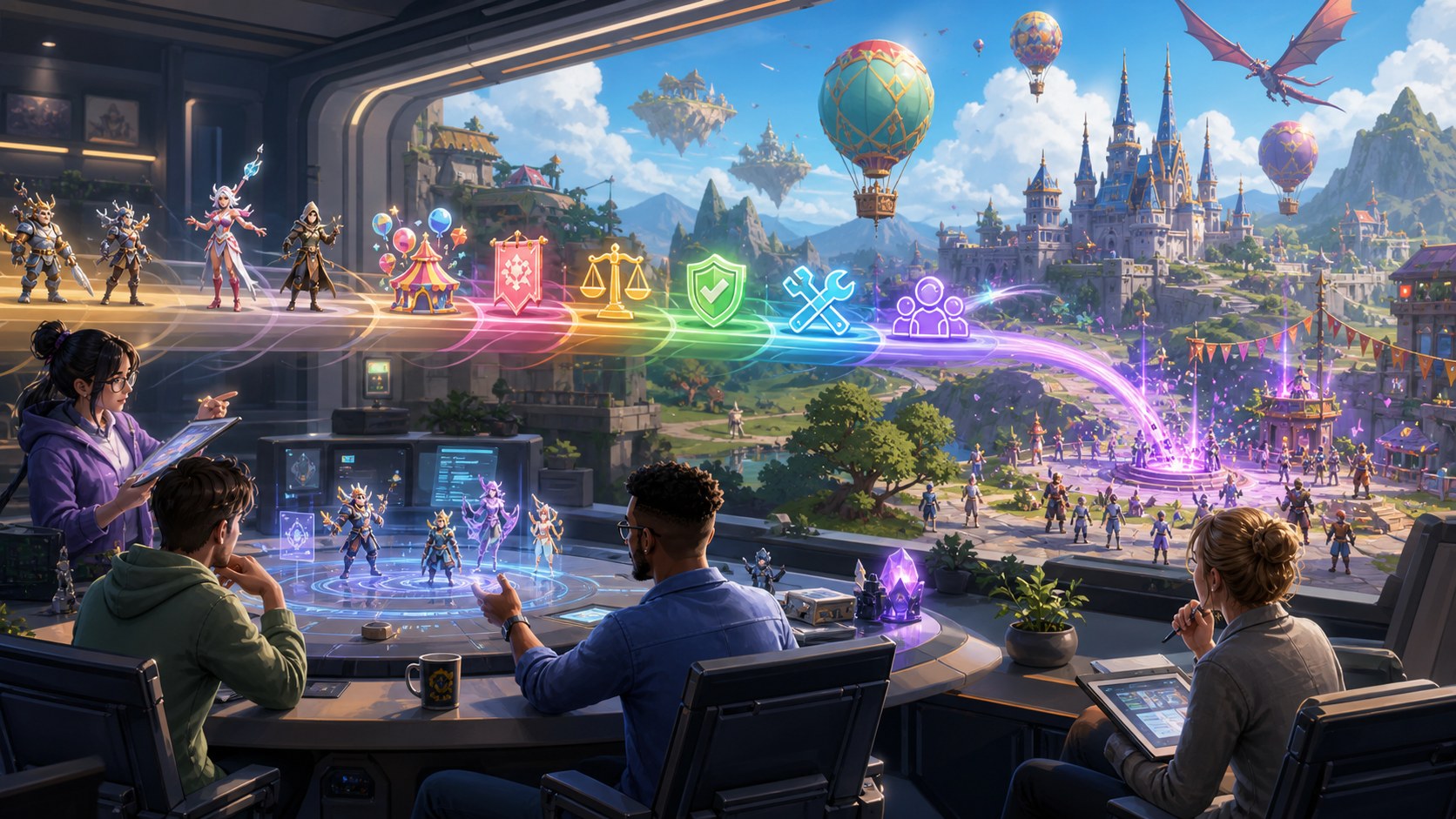
Launching a game feels like reaching the finish line. After months, sometimes years, of development, the game is finally in players' hands. The servers are running, the store pages are live, and the team can finally take a breath.
For a live game, though, that is when the real work starts.
Players finish content. They get used to the mechanics. The excitement of launch fades. Some move on to another game. Others stay, but only if there is something worth coming back for.
This is where LiveOps comes in.
LiveOps, or live operations, is everything a studio does to support and evolve a game after launch: new content, events, balance changes, bug fixes, economy adjustments, community activities, and much more. A good LiveOps strategy does not simply add more content. It gives the game a rhythm and gives players a reason to keep it installed.
Why LiveOps Matters
There was a time when a game could be launched, patched a few times, and largely left alone. That model still works for some premium games, but it is much harder to sustain a free-to-play mobile title that depends on long-term engagement.
Mobile players have thousands of alternatives. If a game becomes repetitive or there is nothing new to do, switching to another title takes seconds.
LiveOps helps prevent that decline. It can give players:
- New challenges to complete
- Reasons to return each day or week
- New characters, levels, items, or cosmetics
- Seasonal experiences
- Opportunities to compete or cooperate
- Fixes for problems that appeared after launch
There is also a business reason. The longer players remain active, the more opportunities a game has to generate revenue through purchases, advertising, subscriptions, or other monetization systems.
But there is an important distinction: LiveOps is not about keeping players busy at any cost. It is about keeping the game interesting.
LiveOps Should Start Before Launch
One of the most common mistakes is thinking about LiveOps only after the game has already been released. By then, it is often too late to build the systems needed to operate the game efficiently.
Before launch, developers should already know how they are going to deliver new content and change parts of the game without rebuilding the whole client every time.
If changing a reward requires a new app update and a lengthy approval process, the team has very little room to react to player behavior. A better setup allows developers to control:
- Event start and end dates
- Rewards and shop offers
- Difficulty and progression values
- Character or item statistics
- Feature availability
- Player segments
Modern LiveOps tooling can combine remote configuration, content delivery, analytics, in-app purchases, economy tools, and targeted push notifications. The exact technology depends on the project, but the principle is the same: build the ability to operate the game before you need it.
Build a Content Calendar
Players do not necessarily need a huge update every week. Trying to produce massive amounts of content constantly can burn out the development team and make the game difficult to manage.
What usually works better is a calendar with different types of updates:
- Small updates: balance adjustments, bug fixes, new daily challenges, small rewards, shop rotations, or minor improvements.
- Events: weekend competitions, holiday events, limited-time modes, community challenges, or special reward tracks.
- Major updates: new game modes, areas, characters, progression systems, social features, or significant gameplay changes.
The cadence should depend on the game. A competitive title may need frequent balance changes, while a narrative-driven RPG may rely more heavily on larger content drops.
There is no universal "update every X days" rule. The important thing is having a schedule the team can actually maintain. Content cadence should match the game's systems, player expectations, and the developer's ability to deliver consistently.
Events Are More Than Decorations
A new background and a few festive rewards do not automatically make a good event. Players need a reason to participate.
A successful event usually changes something about the normal experience. Players might get a special objective, temporary game mode, different progression path, or access to rewards that are not normally available.
A match-3 game could introduce a limited collection event. A strategy game might create a weekend tournament. An RPG could launch a temporary storyline with a new boss.
The event should also fit the core gameplay. If the normal game is enjoyable, LiveOps should amplify that enjoyment rather than distract players with unrelated activities.
Do Not Flood Players With Events
There is another problem on the opposite side: too many events can make a game exhausting.
Imagine opening the game and seeing:
- Three different timers
- Five event currencies
- Multiple battle passes
- A dozen reward tracks
- Several limited-time offers
Instead of making the game exciting, it starts feeling like a second job. Players should be able to understand what is happening without studying a spreadsheet.
A good LiveOps calendar has breathing room. Some events can overlap, but players should not feel that they are permanently missing something. The goal is not to make the player think, "I have to play because 17 things expire today." It is to make them think, "There is something fun happening today. I will play for a bit."
Use Data to Decide What to Change
Once a game is live, developers finally have something they could not get during development: real player behavior at scale.
Analytics can show where players struggle, where they stop playing, which features they ignore, and what brings them back. Useful metrics include:
- D1, D7, and D30 retention
- Session length and frequency
- Churn and conversion rate
- ARPU, ARPPU, and LTV
- Event participation and progression speed
- Ad engagement and purchase behavior
Collecting numbers is not enough. The team needs to ask what those numbers mean.
If an event increases daily activity but players leave immediately afterward, was it really successful? If an offer increases purchases but reduces retention among non-paying users, was the revenue gain worth it? If players complete a new feature once and never return, perhaps it needs another reason to engage.
Post-launch analytics is increasingly focused on linking specific player actions to retention and monetization instead of relying only on broad install-based metrics.
A/B Testing Helps Avoid Guesswork
LiveOps gives developers the ability to experiment with a real audience. Suppose the team wants to change the starter bundle. Instead of immediately giving the new version to everyone, they can test two versions with different groups of players.
The same approach can be used for:
- Tutorial flows
- Event rewards
- Difficulty and progression speed
- Pricing and shop layouts
- Notifications
- UI changes
This is useful because player behavior is often different from what developers expect. A feature that looked great during internal testing might perform poorly with real users. A small change that seemed insignificant can have a surprisingly large effect.
When possible, change one thing at a time and give the experiment enough time to produce useful data.
Keep the Economy Under Control
LiveOps and the in-game economy are closely connected. Every new event, reward, character, currency, and offer affects the economy.
If an event gives away too much premium currency, players may stop buying it. If rewards are too weak, nobody participates. If progression becomes too slow, players get frustrated.
Developers should regularly monitor:
- How quickly players earn and spend currencies
- Inventory accumulation
- Upgrade costs
- Purchase frequency
- Progression bottlenecks
- The behavior of high-spending and free players
A healthy economy is not something you balance once during development and forget about. A live game keeps changing, so its economy changes with it.
Listen to the Community
Analytics can tell you what is happening. Players can often tell you why.
Community feedback can reveal problems that are not immediately obvious in the numbers. Players might complain about:
- An unfair event
- Confusing progression
- Repetitive content
- Poor matchmaking
- Frustrating difficulty spikes
- Missing quality-of-life features
- Bugs affecting a specific device or situation
That feedback can come from Discord, Reddit, social media, reviews, support tickets, or in-game surveys. You should not implement every request, because a vocal group does not necessarily represent the whole audience. But ignoring the community completely is a mistake.
The best teams combine player feedback with analytics rather than treating either as the complete picture.
Do Not Forget Bug Fixes and Quality of Life
LiveOps is not only about shiny new content. Sometimes the most valuable update is a boring one.
A crash fix, faster loading time, improved matchmaking, better controls, or a cleaner inventory screen may not generate exciting marketing headlines, but it can make a real difference to retention.
Players notice when a game is being maintained. They also notice when it is not.
Re-Engage Players Who Have Left
Some players will stop playing. That is normal. The question is whether they are gone forever.
A new update can be a good opportunity to bring former players back. A returning-player campaign might highlight a new character, offer a welcome-back reward, or simply let players know that something has changed.
The key is relevance. A player who left because they finished all available content may respond well to a major update. Someone who left because of a frustrating difficulty spike may need a different approach.
This is another area where segmentation is useful. Modern LiveOps systems can target communications and experiences based on player behavior instead of sending exactly the same message to everyone.
Plan for the First 90 Days
The first few months after launch deserve special attention. A practical roadmap might look like this:
Month 1: Stabilize
Focus on making the game reliable. Fix serious bugs, monitor crashes, analyze onboarding, watch retention, and address problems that players encounter immediately.
Do not rush to add a huge amount of content if the foundation is not working.
Month 2: Learn
Start experimenting. Test events, rewards, offers, progression changes, and different ways of communicating with players. Use what the first month taught you to adjust the roadmap.
Month 3: Expand
By this point, the team should have a better understanding of the audience. This is a good time for a more substantial update: a new mode, major event, new content chapter, or another feature that gives existing players a meaningful reason to return.
Every game is different. The point is not to follow a rigid 90-day formula. It is to avoid treating launch as the end of production.
Your LiveOps Team Matters
LiveOps requires several disciplines to work together. A typical team might involve:
- Game designers
- Programmers
- Artists
- QA specialists
- Producers and analysts
- Community managers
- Monetization specialists
Not every studio needs all of these people in-house. For smaller teams, outsourcing some LiveOps work can be a practical way to maintain the game without dramatically increasing permanent headcount.
External developers can help with new features, content production, QA, optimization, or ongoing technical support while the internal team keeps control over the game's direction.
What matters is that someone owns the process. If nobody is responsible for the LiveOps roadmap, events become last-minute tasks and important problems tend to sit unresolved.
What Makes a Good LiveOps Strategy?
There is no magic formula, but the strongest LiveOps strategies usually have a few things in common. They:
- Give players meaningful reasons to return
- Introduce new content without overwhelming them
- Use data to guide decisions
- Listen to the community
- Maintain a healthy in-game economy
- Leave room for experimentation
- Fix problems quickly
- Plan content far enough ahead to avoid production chaos
Most importantly, a good strategy does not treat LiveOps as a collection of monetization tricks. A game can have ten events running at once and still feel dead if none of them are fun.
Final Thoughts
A successful launch can give a game a great start, but it does not guarantee a long life. Players eventually consume the available content, get used to the mechanics, and move on. LiveOps gives developers a way to respond to that natural lifecycle and keep the experience moving.
The best LiveOps is not about constantly shouting, "Come back! There is a new offer!" It is about giving players something worth coming back for.
That might be a new story chapter, a competitive event, a new character, a better version of an existing feature, or simply a game that feels noticeably better than it did last month.
At Melior Games, we understand that game development does not stop when a title reaches the store. Our team can support projects beyond launch with Unity development, new content, art production, QA, optimization, feature development, and ongoing technical support.
If you are planning a new live game or need additional development support for an existing title, Melior Games can help build a LiveOps approach that fits your game, audience, and production capacity.