
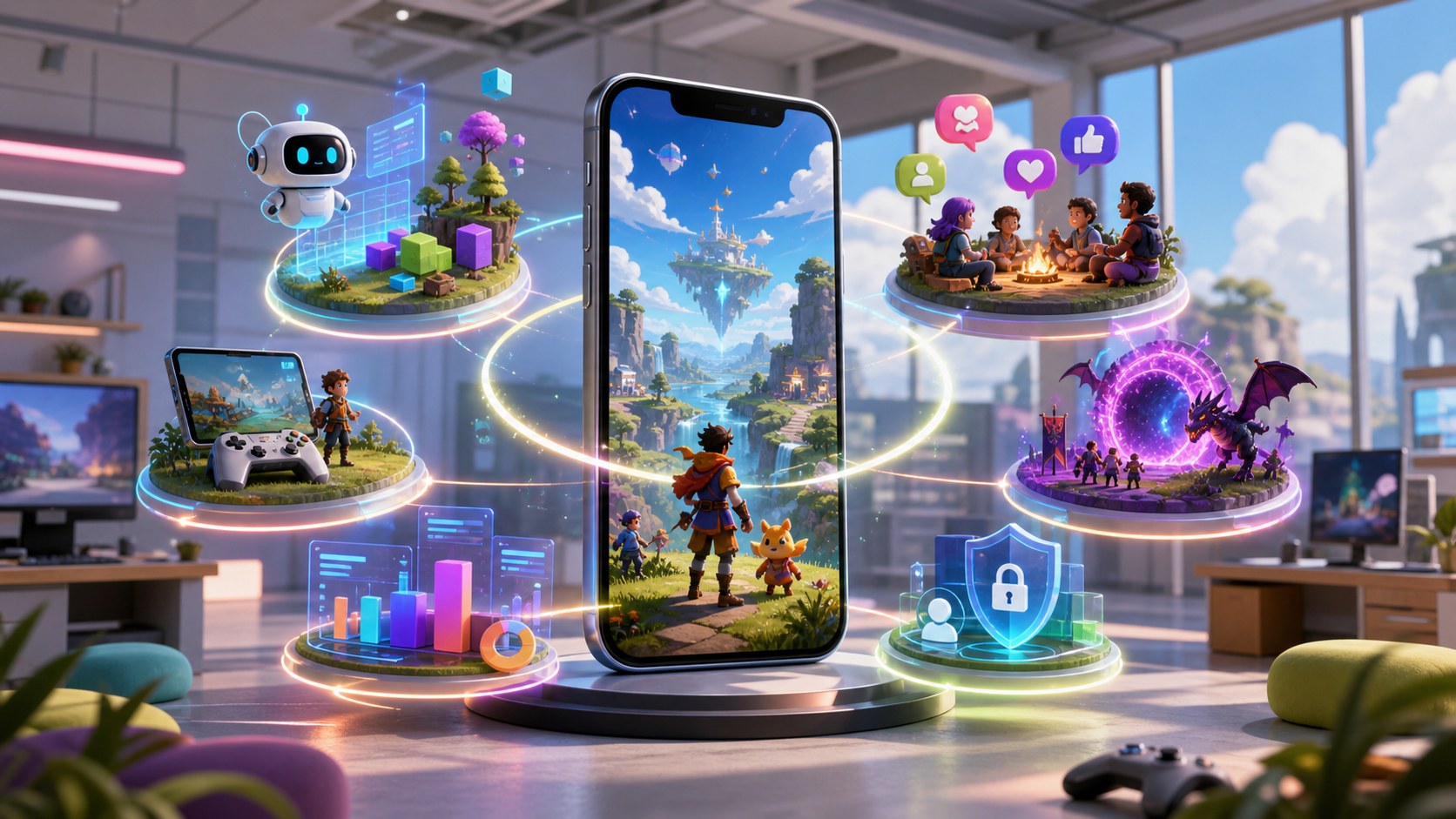
Mobile gaming has changed dramatically over the last few years. The days when a simple game with a few mechanics and a heavy ad load could easily become a hit are mostly behind us. Players have more choice, acquisition is more expensive, and expectations are higher.
At the same time, developers have access to tools and technologies that would have seemed unrealistic just a few years ago. AI can accelerate parts of production, modern phones can handle surprisingly detailed games, and live-service technology makes it possible to keep a title evolving long after launch.
So, what should mobile game developers pay attention to in 2026? Here are the trends we think are worth watching.
AI Is Becoming a Normal Part of Game Development
AI is probably the most obvious trend, but it is also one of the easiest to misunderstand.
We are not at the point where developers can simply type "make me a successful mobile RPG" and receive a finished game. Game development still needs designers, artists, programmers, QA specialists, and producers.
What has changed is how many routine tasks can now be accelerated. Teams are experimenting with AI for:
- Concept and reference generation
- Dialogue and narrative variations
- Prototyping
- Code assistance
- Test case generation
- Localization
- Player behavior analysis
- Creating variations of game assets
There is also an interesting change happening on the player side. AI can make NPCs more responsive, generate varied conversations, adjust difficulty, or create content based on what a player has already done.
The important part is not using AI simply because it is fashionable. A tool is useful when it solves an actual production problem or improves the game.
Hybrid Casual Games Are Still Growing
Hypercasual games proved that mobile players love simple mechanics. The problem is that extremely simple games can struggle to keep people interested for very long.
That is where hybrid casual comes in.
These games retain the easy-to-understand gameplay of hypercasual titles while adding systems that give players a reason to stay. Upgrades, collections, characters, missions, events, or light RPG mechanics can be layered on top of a simple core loop.
A game can be easy to understand within the first minute while still giving players something to work toward after 20 or 30 hours. This combination is attractive to developers because it can improve retention without requiring the complexity of a traditional hardcore game.
Live Operations Are Becoming Part of the Game From Day One
A mobile game is rarely finished when it reaches the App Store or Google Play.
Players expect something to happen after launch. A new event, seasonal update, character, challenge, or simply some fresh content can be enough to bring people back. This makes live operations an important part of development planning.
A live-service mobile game might regularly introduce:
- Seasonal events
- Limited-time challenges
- New characters or equipment
- Cosmetic items
- Battle passes
- Community competitions
- New levels or game modes
Live operations also influence the original design. Developers need systems that can be expanded instead of a game that becomes difficult to update after release. For a new project, it is worth thinking about the second and third months before the first version is even finished.
Cross-Platform Gaming Makes More Sense
Mobile games do not necessarily have to stay on mobile. Players are increasingly comfortable moving between devices. Someone might play on a phone during a commute and continue on a PC or tablet later.
This is particularly relevant for games with longer sessions and persistent progression. Cross-platform development can include:
- Shared accounts
- Cloud saves
- Cross-platform progression
- Cross-play multiplayer
- Synchronized purchases
- PC and mobile versions
It is not necessary for every game. A quick puzzle title may not benefit much from a PC version. For an RPG, strategy game, multiplayer title, or another game with long-term progression, however, cross-platform support can open up a much larger audience.
Mobile Graphics Are Getting More Ambitious
The hardware inside modern smartphones is powerful enough to support games that would have required dedicated gaming hardware not so long ago. This gives developers more room to experiment with detailed environments, better lighting, advanced shaders, complex animations, and larger worlds.
But there is a catch: not every player owns the newest phone. This is why optimization remains just as important as visual quality.
A mobile game may need to run on several generations of devices with very different GPUs, RAM configurations, and screen resolutions. Developers need scalable graphics settings and careful performance testing rather than simply targeting the latest flagship phone.
Good mobile graphics are not necessarily about making everything photorealistic. A well-designed stylized game can look fantastic while being much easier to run across a wide range of devices.
Personalization Is Moving Beyond Recommendations
Mobile games have collected large amounts of player behavior data for years. In 2026, the interesting question is what developers do with that information.
Personalization can go beyond recommending an item in the store. A game might change onboarding depending on how quickly a player learns. It could offer different challenges to competitive and casual players or show content based on what someone actually enjoys.
A player who spends most of their time collecting characters probably does not need the same offers or challenges as someone focused on PvP. Done well, personalization makes the game feel more relevant. Done badly, it simply feels like the game is trying to sell something. That distinction matters.
Social Features Can Keep Players Around
People do not always keep playing because of the game itself. Sometimes they stay because their friends are there.
This is particularly obvious in multiplayer games, but social mechanics can work in many genres. Guilds, clans, leaderboards, cooperative missions, team challenges, trading, and community events all give players another reason to return.
Even a primarily single-player game can benefit from relatively simple social features. Sharing achievements, competing on leaderboards, or taking part in community challenges can add a surprisingly strong layer of engagement. The longer a player is connected to a community, the harder it is for another game to pull them away.
Monetization Is Becoming More User-Friendly
Players have become very good at spotting bad monetization. Constant pop-ups and obvious pay-to-win mechanics may generate revenue in the short term, but they can damage retention and a game's reputation.
Developers are increasingly looking for monetization that feels like part of the gameplay. Common approaches include:
- Cosmetic items
- Battle passes
- Rewarded ads
- Subscriptions
- Expansions and premium content
Rewarded ads are a particularly interesting example. Rather than interrupting the player mid-session, the game offers a benefit in exchange for voluntarily watching an ad.
Player Retention Matters More Than Ever
Getting an install is only the first step. If someone downloads a game, plays for ten minutes, and never comes back, the acquisition campaign has not delivered much value.
This is why developers are paying more attention to the complete player journey. The early experience needs to answer a few basic questions quickly:
- What am I supposed to do?
- Why is it fun?
- What can I unlock next?
- Why should I come back tomorrow?
Hundreds of small decisions influence retention. Tutorial length, loading times, difficulty, reward pacing, progression, matchmaking, notifications, and even the first few minutes of gameplay can make a difference. A strong core loop still matters more than any growth trick.
Analytics and A/B Testing Are Part of Game Design
Data has become an everyday development tool rather than something reserved for the marketing team. Studios can see where players quit, which levels cause problems, which offers perform well, and which features are barely used.
Useful metrics include:
- D1, D7, and D30 retention
- Average session length and sessions per user
- Conversion rate
- ARPU and ARPPU
- LTV and churn
- Ad engagement and progression speed
A/B testing can then be used to evaluate specific changes. A different tutorial may produce better D1 retention. A new starter-pack price may improve conversion. Players may respond better to a weekly event than a monthly one. Instead of arguing about which version "feels better," teams can test both.
That does not mean data should make every design decision. Numbers tell you what is happening. Designers still need to understand why.
Privacy Will Remain an Important Issue
Players are increasingly concerned about privacy and data collection. Developers need to think carefully about what information they collect, why they collect it, and how it is stored and used.
Ideally, privacy should be considered during architecture and design, not added just before release.
Better Development Tools Mean Faster Iteration
Improving development processes helps teams iterate faster. For mobile development, this is especially useful because teams need to test across many devices and operating system versions.
A modern pipeline can automate parts of:
- Building and deployment
- Regression testing
- Performance monitoring
- Crash reporting
- Asset processing
- Analytics collection
The result is not just faster development. It gives teams more opportunities to test ideas, find problems, and make changes before players see them.
What These Trends Mean for Mobile Game Developers
Not every trend needs to become a feature in your next game. That is probably the most important thing to remember.
Adding AI, cross-platform multiplayer, guilds, a battle pass, and procedural content to the same project does not automatically make it modern. It can simply make the game complicated.
The better approach is to start with the game itself and ask which technologies or trends actually support it.
Final Thoughts
AI will make some parts of production faster. Better hardware will give developers more creative freedom. Live operations will keep games evolving, while personalization and social features will help players find more reasons to stay.
A mobile game still needs a good core mechanic. It needs to be fun, understandable, technically stable, and worth coming back to. Everything else builds on top of that.
At Melior Games, we work with companies that want to turn game ideas into commercially viable mobile products. Our team covers game design, 2D and 3D art, Unity development, multiplayer functionality, QA, and post-launch support.
If you are planning a mobile game for 2026 and want to discuss the right technology, features, and development approach for your project, get in touch with Melior Games.