
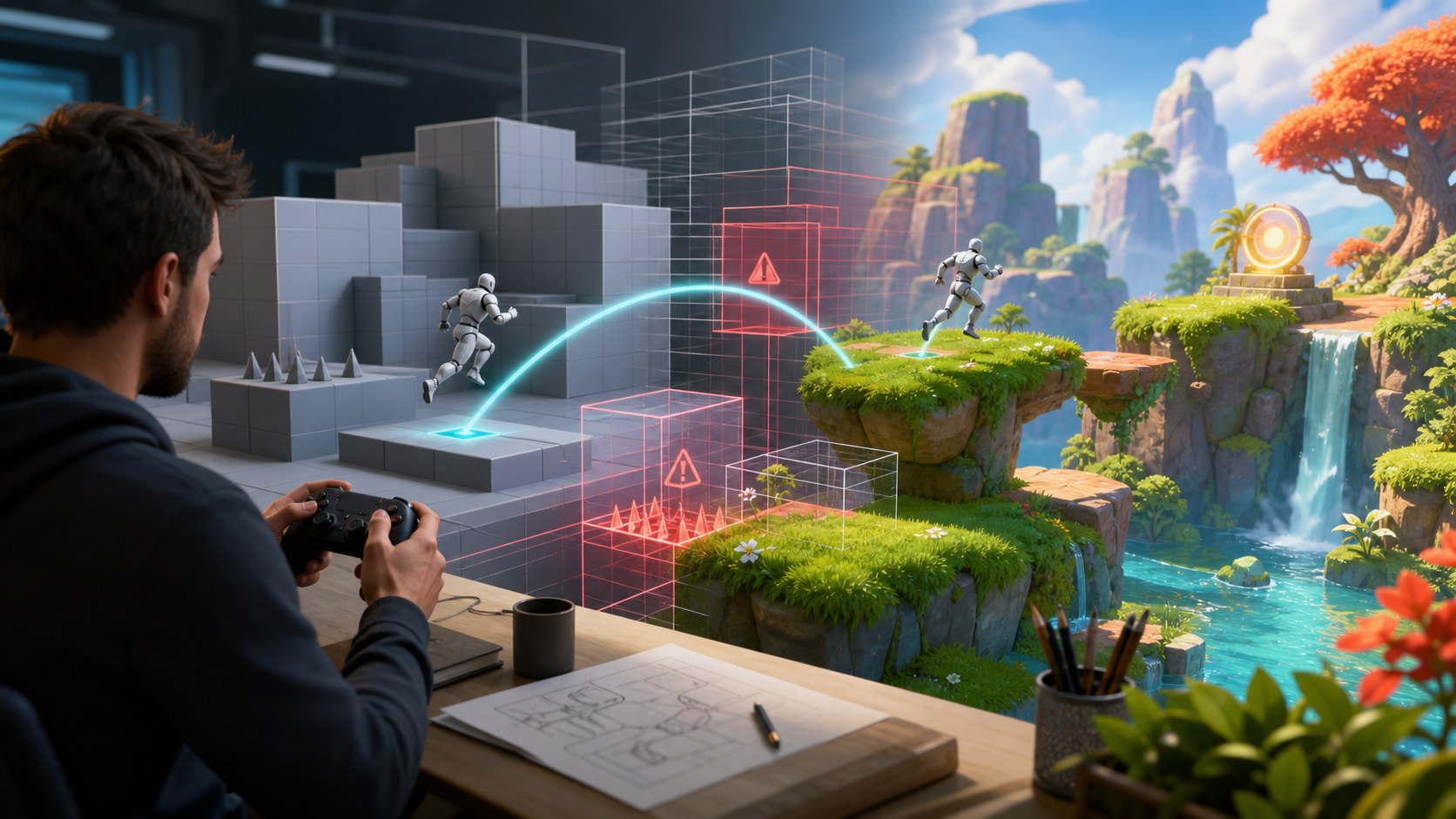
Great ideas are everywhere. Every week, studios hear pitches for innovative mechanics, ambitious multiplayer systems, stylized worlds, or genre combinations that "could become the next big thing." But between a strong idea and a successful game lies a long chain of technical, creative, and production challenges.
This is exactly why experienced studios rarely jump directly into full production.
Before building hundreds of assets, expanding a team, or investing heavily in marketing and live operations, many developers first create a Proof of Concept - commonly called a PoC. Although it may seem like an extra step, a PoC can save months of development time, reduce production risk, and help teams make better business decisions.
What Is a PoC (Proof of Concept) in Game Development?
A Proof of Concept (PoC) is an early gameplay or technical prototype created to test a particular idea before launching it into full-scale production. Unlike a polished vertical slice or near-final demo, a PoC focuses on the core mechanics.
A PoC is not meant to impress players with content quantity. Its purpose is validation.
In many cases, the PoC stage becomes the moment when a project either gains real momentum or avoids a very expensive mistake.
The Earlier You Discover Problems, the Cheaper They Are to Solve
One of the biggest reasons to start with a PoC is simple economics.
Problems discovered during pre-production are dramatically cheaper to fix than problems found halfway through development. A combat system that feels repetitive in a two-week prototype would become a massive redesign challenge after months of animation, VFX, balancing, UI implementation, and level design.
The same applies to technical systems.
A multiplayer synchronization issue discovered during a PoC can still be solved through architecture changes. The same issue discovered close to release may require rebuilding entire gameplay systems or server logic.
Experienced game studios know that uncertainty is one of the most expensive parts of production. A PoC exists to reduce that uncertainty before the project scales.
A PoC Helps Validate the Core Gameplay Loop
Projects built around unusual mechanics, hybrid genres, or experimental progression systems may look exciting on paper but feel completely different once they become interactive. Teams may debate ideas for months before realizing that the gameplay loop does not offer enough long-term interest.
A PoC reveals this early. Once players can interact with the mechanic directly, the team quickly understands whether the experience creates tension, satisfaction, challenge, curiosity, or replayability.
For game designers, this stage is invaluable because it shifts decision-making away from assumptions and toward actual player behavior.
Technical Feasibility Matters More Than Many Teams Expect
Modern games rely on increasingly complex technology stacks. Cross-platform support, multiplayer infrastructure, procedural generation, AI systems, physics interactions, cloud saves, anti-cheat systems, and live-service functionality all introduce technical risks.
A PoC allows engineers to test the hardest parts first.
Teams can assess performance early and identify bottlenecks before production pipelines are fully established.
This becomes especially important for projects involving massive online environments, real-time multiplayer gameplay, cross-platform synchronization, and virtual or augmented reality systems.
PoCs Improve Communication Between Clients and Developers
In outsourced and collaborative development environments, misunderstandings can quickly become costly.
Clients frequently describe gameplay concepts philosophically, while developers interpret them through technical and production realities. To align expectations on both sides, a PoC establishes a common point of reference.
Instead of discussing abstract ideas, everyone can evaluate gameplay feel, visual direction, technical scope, production complexity, feature priorities, monetization integration, platform limitations, and more.
Investors and Publishers Want Validation
The market has become far more competitive over the past decade. Publishers and investors receive countless pitches, many of which never progress beyond presentation materials.
A PoC changes the conversation.
A playable prototype demonstrates commitment, execution capability, and risk awareness. It proves that the team can move beyond concepts into actual development.
Even a relatively small prototype can dramatically improve funding discussions because stakeholders gain visibility into:
- Gameplay quality
- Team capability
- Technical direction
- Production readiness
- Commercial potential
In many situations, a PoC becomes the bridge between an idea and production financing.
PoCs Help Define a Realistic Production Scope
Teams often start with ambitious feature lists, cinematic goals, online systems, and large content requirements without fully understanding the production work behind them. PoCs help establish reasonable expectations early on.
Once developers have built the core systems, they get a clear picture of production speed, technical complexity, and content requirements.
In many cases, the PoC phase leads to smarter decisions about what a game actually needs to succeed.
A PoC Is Not Wasted Development Time
Some studios hesitate to invest in a PoC because they fear "slowing down development." In reality, skipping validation often creates far larger delays later.
A successful PoC rarely becomes discarded work.
Core systems, technical solutions, workflow experiments, and gameplay discoveries often evolve directly into production foundations. Even when certain mechanics change, the knowledge gained during prototyping continues to shape the final product.
More importantly, the PoC phase creates clarity.
And clarity is one of the most valuable assets a development team can have.
How Melior Games Approaches PoC Development
At Melior Games, we believe that a Proof of Concept is the quickest way to determine whether an idea is worth expanding into a full-fledged game.
Our approach is intentionally lean. We create a functional "skeleton" that focuses entirely on the core gameplay mechanics rather than a polished product. A PoC contains the functions required to test the main concept. Menus, a sophisticated user interface, and visual effects are not included. Temporary graphics or basic placeholders are enough to assess whether the gameplay works properly.
A Proof of Concept can typically be completed within a month, giving clients a strong basis for product, funding, and development decisions without committing to a full production budget.